Monday, February 21, 2011

Phnom Penh


 Our first day in Cambodia's capital, we took a thirty minute tuk-tuk ride outside the city to the Artisans d'Angkor silk farm.  Along the way we saw several mopeds carrying four passengers or more, some with children sandwiched into the pile (notice the driver above texting who thought it best to not only leave helmets off his kids but place his smallest child on the back end), others carrying loads so large you could not  even make out the driver at all.  Once at the farm we were given a tour and explained the entire process from silkworm to textile. I had no idea it was such a lengthy and delicate process to make a scarf!  It is a highly impressive process, please click here for another author's great overview.


On our way back to the city I snapped a few images of rice fields.  What a tough job that would be; up to your knees in water sogged soil, bending over to collect tiny rice pellets day after day.  Life in general in Cambodia is hard, 40% of the population are living below the poverty line.  We had read about the  Kantha Bopha Children's Hospital and their desperate need for blood, especially types A and B.  We had our tuk-tuk driver drop us off and within an hour we had successfully left a bit of ourselves in Cambodia in hopes that it would save a life.
 

At dinner that night a local woman was selling these lotus seed pods, which are edible and quite fun to eat.

Apparently we are not the only ones to think so

These monkeys are city dwellers, residing in the park surrounding Wat Phnom

They were quite the entertaining group.  Two youngsters put on quite the show bickering over a pair of mens pants.  This momma seemed to look on with disdain as she nursed her baby.

Wat Phnom, literally temple of the mountains, has been a sacred site since 1373


        The colorful murals in this temple were so elaborate it became one of my favorites from the trip

These young men were practicing for the Chinese New Year celebration


The Tuol Sleng (Hill of the Poisonous Trees) Genocide Museum and the Killing Fields were emotional and perplexing experiences.  A group of us got together and purchased this man's book, a personal account of his story leading up to his imprisonment on to his miraculous survival.  Out of 17,000 estimated prisoners, he is one of only seven who made it out alive.  I had hoped to gain a better understanding of who this maniac dictator Pol Pot was and exactly why he exterminated an unbelievable 21% of his own people.  Unfortunately there is no clear reason, not in the book, not after talking with Cambodians today on their perspectives and what they have been taught, and not after researching a bit of what the history books  say.  I suppose there is no real answers when it comes to genocide, only shock and disbelief that such horrific events are humanly possible.


To lighten the heaviness of such atrocities we ended our day at the bustling market; trying to replace all the images of death with images of life in Cambodia today.


Friday, February 18, 2011

Siem Reap and Angkor Wat

Waving children on the road

New Hope students learning English

Our group sits down to dinner at the New Hope restaurant, a brand new facility that will help fund the organisations many efforts

  Our first day in Cambodia was spent in Siem Reap, a city of 750,000 with a very distinctive visual line drawn between the haves; large modern hotels with well manicured front entrances dotted with tourists, and the have-nots, dusty dirt roads lined with shanties frequented by shoeless children.  We arrived late in the afternoon and went directly to a grass roots NGO, New Hope Cambodia,  where we stepped into the schools classrooms and joined the kids in their English lessons.  They were a smiling, talkative bunch and we took turns asking all kinds of questions.  Their English was amazing, their stories were sad.  The majority of students were orphans, having lost their parents to war or disease.  Thanks to this organisation 150 children are receiving an education, 180 impoverished families are receiving food, and up to 100 sick per day are being treated with medical care.  After class we headed over to a freshly built one room restaurant and listened to the volunteers talk more about what New Hope does and what we can do to help.  This is a truly remarkable organisation with far reaching goals, please consider making a donation here.

Angkor Wat slowly revealing itself with the sunrise


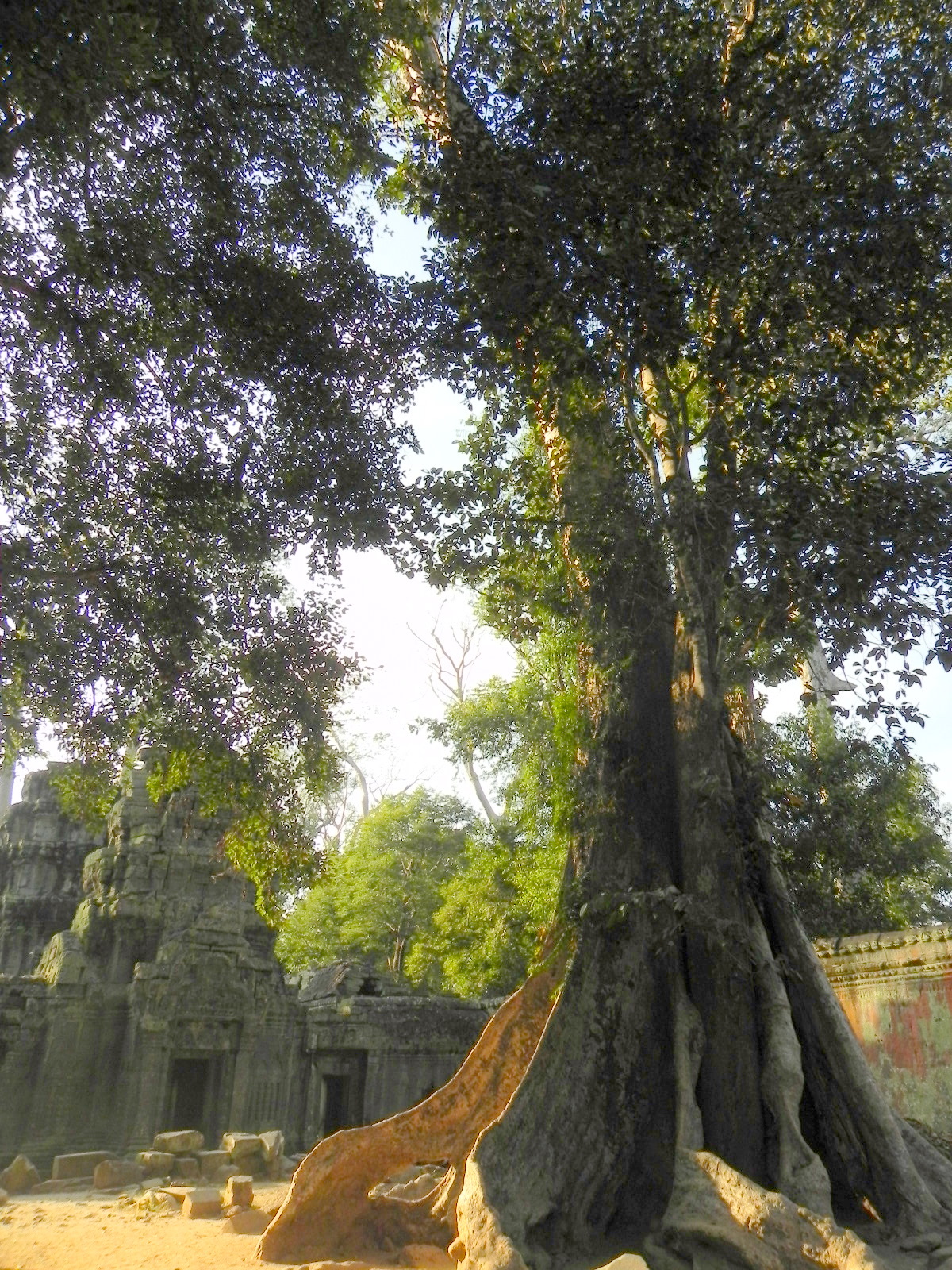
At 4am in the pitch dark the following morning, armed with a headlamp and a flashlight, we were crossing the threshold of the largest religious monument ever constructed, the capital of the Khmer kingdom from 802 to 1295.  I had grand notions of what to expect at Angkor Wat, literally "city temple," quite fitting considering the entire complex is a spansive 37 square mile city in itself, tough to navigate purely in a day.  Once the sun started to spread light on a temple fronted by massive ponds, (water storage vital to the inhabitants in it's days of glory) every minute added excitement.  We traversed through the highlights, each more impressive than the last.  Every wall of every temple was something to marvel; stone reliefs told mysterious stories of the past, the detail mind boggling when considering the vast quantity contained in the entire complex. And speaking of pictures, they can't begin to give the experience justice but please see below. From wikipedia:

One of the first Western visitors to the temple was Antonio da Magdalena, a Portuguese monk who visited in 1586 and said that it "is of such extraordinary construction that it is not possible to describe it with a pen, particularly since it is like no other building in the world. It has towers and decoration and all the refinements which the human genius can conceive of".[5]
 However, the temple was popularised in the West only in the mid-19th century on the publication of Henri Mouhot's travel notes. The French explorer wrote of it:
"One of these temples—a rival to that of Solomon, and erected by some ancient Michelangelo—might take an honourable place beside our most beautiful buildings. It is grander than anything left to us by Greece or Rome, and presents a sad contrast to the state of barbarism in which the nation is now plunged."[6]


All images by PepperKeyStacie

Tuesday, February 15, 2011

Bangkok

The door to our room

Study overlooking garden

Two of the ponds residents

Dining pavilion at sunset

Thousands of orchid blooms lined this walkway

Pond and gazebo at dusk

 
 It has been a fast moving last six weeks, now that we are back it seems only a blink of an eye.  After a night in New York with dear friends we were en route to Bangkok, a bustling city of 8 million, famous for palaces and temples but well reputated for being sinful and seedy.  As large cities are usually an avoidance for us, I was careful to book a hotel in Old Bangkok I hoped would be an oasis from the noise and crowds.  Chakrabongse Villas exceeded my every expectation.  From the lush gardens surrounding ponds and water features, to the riverside dining pavilion with traditional furnishings, every inch was beautifully presented and maintained.  Built in 1908 by Prince Chakrabongse, the house was originally used as his leisure residence, a perfect spot for picnics and river rides after attending royal ceremonies in the Grand Palace.  After the 1932 revolution the house became home for Prince Chula Chakrabongse, a writer and historian whose daughter Narisa would later open the property as a boutique hotel to lucky visitors such as ourselves.  The dining pavilion sits on  the Chao Phraya River (River of Kings), which cuts through the heart of the city.  The upper deck was our favorite frequent; a great spot for morning yoga while watching the city come alive as well as sunset cocktails followed by city lights. 


Tuk-tuk drivers will try to pursuade you to stop at various merchant or tailor shops. Persistent and firm no's are usually necessary to get you to your desired destination

After wandering through the fragrant flower market and a chaotic visit to the Grand Palace (where we ducked into the above bonsai garden to escape the masses of people), we spent a romantic end to our one year wedding anniversary aboard an old wooden monohull ship, sampling traditional thai food and being entertained with live music and dance. 


The floating market was another highlight, just a short trip from the city, a colorful food and photo fest.


All images by PepperKeyStacie