Showing posts with label Norway. Show all posts

Friday, May 28, 2010

Vakre Hjem & Interior Magazine

To wrap up my postings on Norway I must relay this gem of a magazine I discovered on my trip.  I knew based on the cover image and paperweight alone, I was going to fall in love with what I would find inside.  I just didn't realize I would adore 99% of what I saw inside, despite the fact that I could not read a word!  Vakre Hjem & Interior literally translates to "Beautiful Homes and Interiors."


Images by Annette Nordstrom of STEEN ART Design


Images by Ragnar Omarsson


Images by Carina Olander


Images by Signe Dons


Images by Ragnar Omarsson

Images by Tom Haga

Wednesday, May 26, 2010

Bergen

All Images by Pepper Key Stacie

I stayed at the Steens Hotel, a fantastic historic bed and breakfast a 15 minute walk to Bryggen.   The images above were taken from a neighboring park, apartment, and the Naturhist Museum gardens.


Bryggen, the old wharf in Bergen, is known worldwide as a UNESCO World Heritage Site.  The area Bryggen rests on is the oldest part of the city of Bergen, which was founded in 1070.  In 1360 a Kontor, or foreign trading post, was set up there for the Hanseatic League.  I enjoyed a Hansa (originally made in Bergen, name stems from the shortened term for Hanseatic League) beer while watching the boats and people on the wharf.  I then walked through a narrow boardwalk passageway between the buildings to find my dinner spot, Bryggen Tracteursted.  I chose a traditional Nordic meal of smoked salmon soaked in aquavit over grilled asparagus followed by a tomato based cod stew.  After drinking the last drop of red wine and eating the last crumb of bread (consistently nutty, hearty and delicious all throughout my travels in Norway) at my candle lit table (another consistent tradition for all meals) I thought to myself I couldn't have asked for a better last evening in Norway.


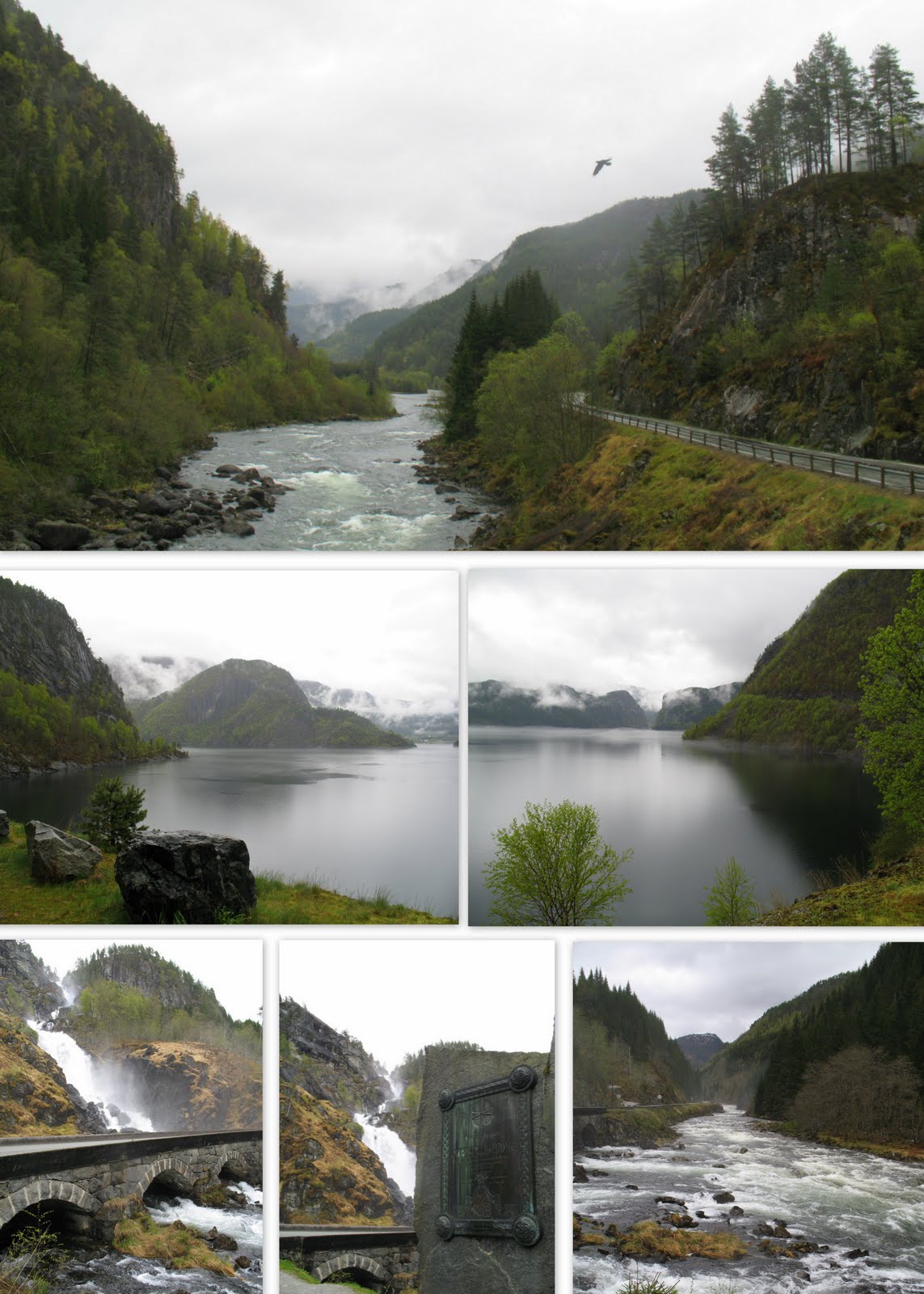
Scenic views en route to Bergen from Rosendal

Rosendal

All images by Pepper Key Stacie
This stone features the Norwegian coat of arms, the golden crowned lion with ax, an insignia from the High Middle Ages

Kvinnherad church is one of the oldest stone churches in western Norway.  It was completed in a mixture of Romanesque and gothic styles in 1250.  It was subject to the Barony Rosendal until 1910 and the first families lie embalmed in a separate sepulchre.


The Barony Rosendal, the smallest castle in Scandinavia, was built by Danish nobleman Ludwig Rosenkrantz.  When he married Karen Mowatt, Norway's richest heiress at the time, the farmland was given as a wedding gift.  The castle was completed in 1665 but the English renaissance gardens were not  planted until the 1850's.  Famous author Henrik Ibsen, Jonas Lie, Alexander Kielland and painters Hans Gude and Anders Askvoll visited often and musicians such as Edvard Grieg and Ole Bull were guests. Today there are still concerts played here, as there were centuries ago, and new additions include a bed and breakfast and an adorable greenhoused restaurant on site.

May 17th, Norway's National Day

All images by Pepper Key Stacie
The large parade in Odda and a tiny cemetery in Sand
The constitution of Norway was signed on May 17, 1814 which declared Norway an independent nation.  It is a very non military national day, marked with childrens parades and most attendees wearing the traditional Bunad.


I pulled up to the Roldal stave church luckily just moments before the parade marched to it's front wall.   I stayed for mass, which I understood not a word but enjoyed the candlelight chandeliers casting light on the richly painted wall paintings that had been finished in the Middle Ages.  Many pilgrims visited this church, originally built in the 1300's, as it was said to have a crucifix which drops of water emerged every Midsummer Night that had healing properties.  This church was reconstructed in the 1900's where a dispute occurred due to it's construction whether it classified as a stave or post church. 

Many scenic stops along the way from Sand to Rosendal

Hjelmeland

All images by Pepper Key Stacie
My great grandfather Jacob Aanen Steensland was born September 26, 1879 in Hjelmeland, Rogaland County, Norway.  Although I wish I would have been able to find more information on the exact place of his birth or the family farm, it was remarkable just to lay eyes on the region of our roots.  Jacobs father was Aenen Jorgensen Stensland, and mother was Borghild Larsdatter Tuntlandsvikane (how's that for a name!) and they, like many Stenslands or Steinslands, changed their spellings to Steensland after moving to America.  I have always found the Norwegian pronunciation easier on the tongue and the ears. 
Hjelmeland is known for it's fruit production; apples, plums, pears, strawberries, and cherries but salmon, cod, and halibut have been important to the fishing industry.  The coat of arms depicts a red shield with plaits of straw, based on the local tradition of furniture making, symbolising the strength and solidarity of the municipality.  These famous chairs with seats of woven twigs, jaerstolen, are still being produced today. 
Reading Summer Light I found a treasure chest of personal parallels.  I grew up in Wyoming; the mountainous and mineral rich equality state, the 10th largest in square mileage but the least populated, and a racially undiverse population at that. Norway, like the rest of Scandinavia, is large but relatively sparsely populated, mountainous and rich in natural resources.  It is a notably egalitarian country, most likely stemming from the Viking days when the farms and communities would be managed by the women while the men were off to sea. Norway is slowly changing but very recently was the most racially homogeneous nation in the world after Japan.  Wyoming has often been termed rough terrain and as the author writes "I ponder the fact that Norway's character has emerged from it's rugged terrain and fragmented coastline, and that the isolation imposed by it's mountains and fjords strenthened it's traditions." (p.66) I think it's fair to say Wyoming's isolation from metropolitan areas has given it an identity all it's own.  With the comparisons of geography and economy I caught myself comparing myself to the average Norwegian and discovered my bad habit of bartering down is classically Norwegian.   Farmers would start at a price lower than they wanted and wait for the buyer to suggest a higher price they would then agree on.  (if only I sold my works to other Norwegians:)  I found out the Steensland's do it yourself nature is inherent; "Norwegians, probably because of their enforced isolation in many of the valleys and on the coastline, have developed a talent for being independent and this quality is reflected in their aptitude in building their own homes, putting on additions, restoring furniture, tending to a vegetable garden, making handicrafts, knitting, weaving, carving wood, and just about any other handyman pursuit." (p. 177)  We share a distaste of plastic surgery, drunk driving, television, and the exploitation of women, and a reverence for fairness, reading, the great outdoors, and gender equality in the workplace and in the home!  The author clearly holds a great deal of respect for Norwegians, describing them as idealistic, good natured, earthy, and wholesome.  In a study a few years back, researchers left wallets with cash unattended in various countries in public places.  Norway was the only country that all five wallets were returned.

Sunday, May 23, 2010

Stalheim and Surrounds


All images by Pepper Key Stacie

The original Stalheim hotel was built in 1885 but only a short decade later had expanded to accommodate up to 150 guests due to it's immense popularity.   As one can see from the top photo, the view is unparalleled.  My favorite feature was the open air museum, a very peaceful place for an early morning walk.  This felt like stepping directly into the old Stalheim community; the coaching inn from 1750, the memorial stone to Emperor Wilhelm’s visits to Stalheim, the schoolhouse from 1881, and the manor house.  The interior of the hotel is also a virtual museum with it's many artifacts, antiques, and art works, many of which feature Stalheim in it's depictions.  The fireplaces were always ablaze by dinner time, an open invitation for all guests to congregate and socialize over coffee, hot tea, or a cocktail.  Our young crew were put to shame with the golden agers, who far outlasted us in the evenings.  While we were saying our good nights and heading to bed between 10 and 11pm (which always felt strange considering there was still plenty of daylight at those hours), they were just getting warmed up in their card games and conversations. 


 So while the evenings were spent in the cozy atmosphere of the above pictures, the days were spent working in some of the most incredible locations I have ever seen.   The photo shoot was for the performance line of ECCO, a global leader in innovative comfort footwear.  The company was founded in 1963 in Denmark by Karl Toosbuy who vowed that the foot should lead the shoe and that comfort should not be a luxury.  The small Danish company has now grown to the 7th largest shoe brand in the world but continues to stay true to it's roots and admirable mission statement
 

Meet the crew:
Photographer Michael Dwornik
Video Director Scott Fredette of light-borne
Art Director Ron Pushkar
Photo Assistants Shane Mccauley and James Loveday
Producer Cindi Blair

Big thanks to everyone who made this shoot a success; Mogen, Patti, Rob, Pal, Christian, Erik, and Bernadette, everyone was great!


Saturday, May 22, 2010

Norway Overview


These were my first views of Norway, flying into Bergen.  Moments earlier I had just finished the last page of Summer Light; A Walk Across Norway by Andrew Stevenson, which was a fantastic introduction to the country before my trip (thank you Siri!).  The book gave me a great deal of insight.  I discovered approximately 3% of Norway is cultivated, some 90% is gorgeous, untouched nature and only around a half percent is considered urban.   It is one of the most sparsely populated countries in all of Europe.  Interestingly there are as many Norwegians living in Norway as there are descendants of Norwegian immigrants living in North America, approximately four and a half million.  My ancestors migrated to the US in the 1860's and 70's, a small few amongst the 800,000 that made the journey between 1840 and 1923.  Visiting their homeland and learning about the many idealistic qualities and inherent nature of the people has given me a profound respect for my bloodlines.  In the book there is a reference to a journal entry where a traveler relays how Norway stayed in his great grandparents hearts long after they moved to America and now, for this family on their first visit, it will forever remain in theirs. My sentiments exactly;  though I left three days ago, I have dreamed of the majestic mountains and fjords every night since my departure.  The fitting words to the Norwegian national anthem:

JA, VI ELSKER DETTE LANDET (Yes, we love this country)

Ja, vi elsker dette landet, (Yes, we love this country)

som det stiger frem, (as it rises forth,)

furet, værbitt over vannet, (rugged, weathered, above the sea,)

med de tusen hjem. (with the thousands of homes.)

Elsker, elsker det og tenker (Love, love it and think)

på vår far og mor (of our father and mother)

og den saganatt som senker (and the saga night that sends)

drømmer på vår jord. (dreams to our earth.)

og den saganatt som senker (and the saga night that sends)

senker drømmer på vår jord. (sends dreams to our earth.)