Showing posts with label plant species. Show all posts

Friday, April 12, 2013

Field Guide Friday - Butterfly Weed

Images via B. Naqqi Manco

Asclepias Curassavica, locally known as butterfly weed, is a flowering plant in the milkweed family, Asclepiadaceae.  As one would guess, the sap of this plant is milky (and rumored to be poisonous, especially damaging to the eyes).  It's local name references it's attractiveness to butterflies, as well as birds and bees, who like to visit the blossoms.  It is a nice addition to a flower garden, typically growing 2-4' tall and flowering from spring until fall.  I love the wispy nature of these flyaway seed pods, so pretty!

Friday, March 8, 2013

Field Guide Friday - Brahmi Herb

 Images via B Naqqi Manco

This pretty little bell shaped flower comes from the Brahmi herb, Bacopa monnieri.  These images were taken from North Wells, Grand Turk, a perfect location for this wetland inhabiting species.  They can tolerate brackish waters or muddy shores, mostly residing in the east in Nepal, Thailand, Vietnam, Nepal, Sri Lanka, and China.  It has been used for over 3,000 years in Ayurvedic medicine, please read an interesting recent study on it's effect on human memory here. Some of the southern states, and we here in the Turks and Caicos, are lucky this lovely lives here!  Besides medicinal, common uses for the species are for aquariums and ponds.  If you happen upon one, many have reported success with propagation from cuttings.

Friday, February 15, 2013

Field Guide Friday - Passionflower Vine


 Image above via passionflow, all images below via B Naqqi Manco

I had planned a few weeks ago, in honor of yesterday, that the Field Guide Friday post for today would be the Passionflower Vine, a member of the Passiflora family.   I thought surely the name must come from it's exotic shape, accompanied by some dashing romantic narrative.  Would you have guessed that in actuality it is handed down from Christianity?
"Early explorers and missionaries to this hemisphere, specifically to South America, named these dramatic vines Passiflora or passion flower to help in their conversion of native Americans to Christianity. They saw and used the beautiful intricate flower parts to tell the story of the death of Jesus, making the story more memorable to listeners. The legend they told is that the passion flower's ten petals and sepals represent the ten apostles present at the crucifixion. The filaments portrayed the crown of thorns, or the halo about Jesus' head. The stamens, of which there are five, suggest the five wounds to Christ's hands, feet and torso. Other parts of the flower and leaves are also used to represent aspects of Christ's passion."
 Quotation from virtualherbarium


This ruby colored lovely is the Passiflora cuprea, or red passionflower vine. Many species of passionflowers are often known to need a large bee (perhaps our big black carpenter bee here in the TCI), hummingbird, bat, or wasp to effectively pollinate due to their unique structure. These vines can reach 30-40 feet in length, making them useful for colorful arbor climbers and dappled shade makers.  They appear to be undemanding, liking well drained soil with sun to partial shade, and as they bloom nearly all year producing a pleasant fragrance, a gardener would receive an abundant return for their care.


The below beauty is the White passionflower vine, Passiflora pectinata, the most common of passion vines in the Turks and Caicos Islands.  They are an unforgettable flower, only fitting that they have such a significant namesake!

Friday, February 8, 2013

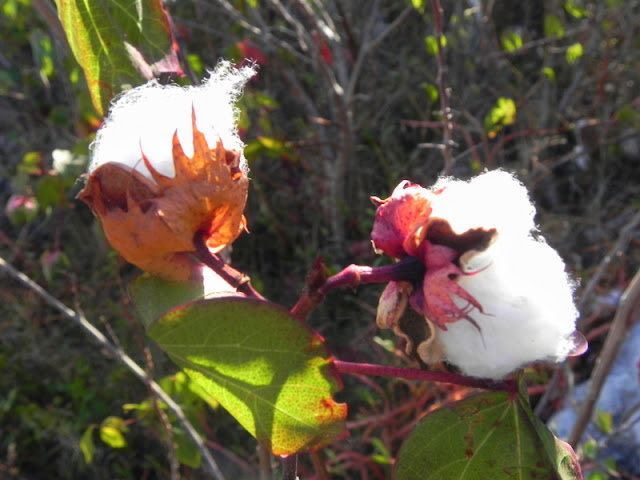
Fieldguide Friday - Wild Sea Island Cotton


I am ashamed to admit just how long it has been since I have featured a Field Guide Friday post.  That is all going to change now that I have a file folder full of local species identified (thank you Naqqi)!  First up, locally known as Wild Cotton or Sea Island Cotton, Gossypium hirsutum.  The photos above were taken in January of 2012 on the way to Southwest Bluff, an area where there were a great concentration, but if you are driving around Providenciales this time of year you are likely to see these fluffy white poofs by the side of the road in many areas.  Contrary to popular belief, it was not the British Loyalists who introduced this species to the Turks and Caicos.  It came long before, but by whom?  For a couple of hints, reference the wikipedia link above; "native to Central America" and "cultivated for over 5,000 years."  A people who were weaving the cotton, not into clothing, but very cleverly into sleeping hammocks and mosquito netting. Have you figured it out?  Whether your certain or stumped, you must read this fascinating article to discover this and so much more: Back In Time Sea Island Cotton.


 Image above and images below via the brilliant botanist, B Naqqi Manco, who captured this thriving wild cotton in Lorimers, Middle Caicos in 2012.  Remarkable the white and pink colored blossoms stemming from the same plant!  This lovely looker seems to be spared entirely from the Cotton Seed Bug, Oxycarenus hyalinipennis.  Referencing this CAPS Survey Report; "In the
Western Hemisphere, it was first documented in the North Caicos Islands in 1991 (Slater
and Baranowski 1994); and by 2005, it had been observed throughout the Turks and
Caicos, the Bahamas, the Cayman Islands and Hispaniola (Baranowski and Slater 2005)." 


The cotton industry in the Turks and Caicos was sadly quite short lived due to the invention of the Cotton Gin, the quality of the soil, and another unfortunate pest, the Boll Weevil.  I have often thought about creative uses for the cotton we still have growing on this island, someday I will hopefully have the opportunity to style with the fluffy stuff like this rustic-wedding-decor-creative-with-cotton!

Friday, May 11, 2012

Fieldguide Fridays - Bearded Cactus

 Easily spotted "bearded" tips of the Dildo Cactus, Longbay, image by Larry Steensland

 The most common species of cactus in the Turks and Caicos Islands is locally known as Dildo Cactus, Pilosocereus Royenii.  The tubular shaped branches often display white tufts at the tops, giving it another common name, "Old Man Cactus" or "Bearded Cactus."  It is native to the Caribbean and Mexico's Yucatan Peninsula.  They resemble trees in that they are often seen towering above the rest of the local vegetation reaching at heights over 20 feet tall.


A now labeled beautiful specimen on the  longbay-beach-barn nature trail.  Amazing that all those branches are supported by the single stalk.


Friday, May 4, 2012

Field Guide Fridays - Poisonwood

Above and following two images below from duke.edu


It has been far too long since I posted in field-guide-fridays!  I have a project at hand to create signage for the longbay-beach-barn nature trail and the decision of which sign to make first was simple. If there is only one species you should recognize and remember, this species would be it! Locally known as Poisonwood, the Metopium Toxiferum species is one you should go to great lengths to avoid in the Turks and Caicos Islands!  A member of the cashew or sumac family (Anacardiaceae), the urushiol the plant produces is a severe skin irritant.


 First sign completed!  I hope to identify and label a dozen prominent indigenous species so trail hikers and Provo Ponies horseback riders can familiarize themselves with our beautiful bush!  In the meantime, you will want to steer clear of this species after reading the below excerpt (and photo) from sfrc.ufl.edu.

"Its range in tropical America extends from Florida to the Bahamas, Honduras, and the West Indies.

The sap contains alkaloids that cause serious skin and mucus


Twigs and leaves
irritations after skin contact. Any part of the tree may carry the sap so handling any part of the poisonwood should be avoided. If you live or work in south Florida the ability to recognize and identify poisonwood is beneficial. You can find poisonwood inhabiting hammocks, pinelands, and sandy dunes near salt water.
The wood is dark brown streaked with red and is heavy and hard, but is not strong. The wood has no commercial value. The gummy sap of the bark has been used medicinally but with extreme caution. The fruit of the poisonwood is a favorite food source for the rare white-crowned pigeon. Other birds and animals also enjoy the fruit."
 Identifying Characteristics
Size/Form:
Poisonwood is an evergreen shrub or medium tree that reaches heights of 25' to 35' or taller. It characteristically has a short trunk with stout arching limbs and drooping branches that form a spreading, rounded crown. Poisonwood is often a shrub in the pinelands and a larger tree in the hammocks.
Leaves:
The leaves are odd-pinnately compound, alternately arranged, 6" to 10" long, and have 3 to 7, usually 5 leaflets. Each leaflet is 3" to 4" long by 2" to 3" wide and broadest near the base or middle. The oval to elliptical leaflets have smooth, glossy, dark green upper surfaces and are paler underneath. The leaf stem is smooth or finely hairy and swollen at the base. The leaflet base is wedged, rounded, or heart-shaped and the tip is acute or rounded. In addition to its leathery appearance, the leaflet has a margin that is thickened, slightly curled, and entire. Many leaflets will be blotched with irregular spots of black resin.
Fruit:
The fruit is a yellow-orange drupe that is about ½" long. The fruit hangs loosely in clusters and each drupe contains one, ¼", hard, brown seed.
Bark:
The reddish-brown or gray bark is thin and has dark, oily patches from the gummy sap. Older trunks have scaly bark.
Habitat:
Poisonwood grows near salt water on shorelines and in sandy dunes, tropical and coastal hammocks, and rockland pinelands.