Showing posts sorted by relevance for query field guide Friday. Sort by date Show all posts

Friday, February 15, 2013

Field Guide Friday - Passionflower Vine


 Image above via passionflow, all images below via B Naqqi Manco

I had planned a few weeks ago, in honor of yesterday, that the Field Guide Friday post for today would be the Passionflower Vine, a member of the Passiflora family.   I thought surely the name must come from it's exotic shape, accompanied by some dashing romantic narrative.  Would you have guessed that in actuality it is handed down from Christianity?
"Early explorers and missionaries to this hemisphere, specifically to South America, named these dramatic vines Passiflora or passion flower to help in their conversion of native Americans to Christianity. They saw and used the beautiful intricate flower parts to tell the story of the death of Jesus, making the story more memorable to listeners. The legend they told is that the passion flower's ten petals and sepals represent the ten apostles present at the crucifixion. The filaments portrayed the crown of thorns, or the halo about Jesus' head. The stamens, of which there are five, suggest the five wounds to Christ's hands, feet and torso. Other parts of the flower and leaves are also used to represent aspects of Christ's passion."
 Quotation from virtualherbarium


This ruby colored lovely is the Passiflora cuprea, or red passionflower vine. Many species of passionflowers are often known to need a large bee (perhaps our big black carpenter bee here in the TCI), hummingbird, bat, or wasp to effectively pollinate due to their unique structure. These vines can reach 30-40 feet in length, making them useful for colorful arbor climbers and dappled shade makers.  They appear to be undemanding, liking well drained soil with sun to partial shade, and as they bloom nearly all year producing a pleasant fragrance, a gardener would receive an abundant return for their care.


The below beauty is the White passionflower vine, Passiflora pectinata, the most common of passion vines in the Turks and Caicos Islands.  They are an unforgettable flower, only fitting that they have such a significant namesake!

Friday, July 8, 2011

Field Guide Fridays - sneak peak


   Over the last couple of years I have gained a whole new appreciation for local flora and fauna.  With Fleur de Lys Villa there was such a steep learning curve with the landscaping, one I am very proud of having gone through and learned many lessons from.  The villa boasts a wide variety of beautiful tropical species, many chosen based on their aesthetic properties.  Some have taken root, multiplied, and flourished. Others have sadly suffered in their surroundings and slowly wilted away.  For the last week I have been in the garden every day for the first time in many months, toiling away during rain and shine.  At the end of an eight hour day, full of dirt and grime and sweat from all the labors of yard work, I plump down in the courtyard sofa and listen to the birds sing and enjoy the peace and serenity of the surroundings my hands, and many others, have put so very many hours into.  It's a classic case of "if I knew then, what I know now."  If I only would have found my appreciation for local species before we started building and slowly evaluated what indigenous trees, shrubs, vines, and flowers would have worked beautifully for our vision.  Do I think we could have achieved the same lush, romantic feel?  Absolutely.  It possibly just would have taken another decade for these local species to grow to great heights but I do believe they would be far more likely to be resilient to sickness and disease, acclimated to the challenging Caribbean climate, and long lasting without the constant care and attention.
   With our new project in Longbay Hills, I have vowed not to put ANY non native species into the ground (other than our fruit and vegetable garden and compost heap).  It will be a challenge but a great experiment I look forward to.  I hope others learn from our situation and take a moment to walk through the beautiful bush, stop and smell the flowers, watch the insects and animals and really appreciate this highly unique environment in which we live and/or visit.  There is no reason not to use native species in your home garden and it is an absolute crime against nature to clear cut what has taken hundreds of years for Mother Nature to nourish.  Love where you live! I would like to continue my learning and expand my appreciation, but also strongly hope to spread that knowledge and curiosity to others, thus every Field Guide Friday will feature a native plant or animal species here on Pepper and Pikey.  Stay posted!

Friday, September 23, 2011

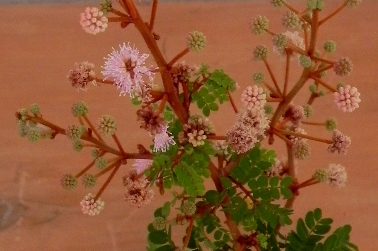
Field Guide Fridays - Catclaw Mimosa


Today's field guide Friday post follows the old saying "can't read a book by it's cover."  As sweet and pretty as these pink puffball flowers look,


this is one species you DO NOT want to touch!

Catclaw is the common name for good reason; Mimosa bahamensis has hook shaped spikes or thorns that grab and don't let go!  I have many times been caught by this tree while hiking in the bush and can attest that it does not discriminate.  It will latch on to heavy duty jeans, cotton shirts, or bare skin.  Please watch for out for this tree when exploring in the Turks and Caicos Islands.  To read more about this genus and species please see zipcodezoo.


Friday, February 8, 2013

Fieldguide Friday - Wild Sea Island Cotton


I am ashamed to admit just how long it has been since I have featured a Field Guide Friday post.  That is all going to change now that I have a file folder full of local species identified (thank you Naqqi)!  First up, locally known as Wild Cotton or Sea Island Cotton, Gossypium hirsutum.  The photos above were taken in January of 2012 on the way to Southwest Bluff, an area where there were a great concentration, but if you are driving around Providenciales this time of year you are likely to see these fluffy white poofs by the side of the road in many areas.  Contrary to popular belief, it was not the British Loyalists who introduced this species to the Turks and Caicos.  It came long before, but by whom?  For a couple of hints, reference the wikipedia link above; "native to Central America" and "cultivated for over 5,000 years."  A people who were weaving the cotton, not into clothing, but very cleverly into sleeping hammocks and mosquito netting. Have you figured it out?  Whether your certain or stumped, you must read this fascinating article to discover this and so much more: Back In Time Sea Island Cotton.


 Image above and images below via the brilliant botanist, B Naqqi Manco, who captured this thriving wild cotton in Lorimers, Middle Caicos in 2012.  Remarkable the white and pink colored blossoms stemming from the same plant!  This lovely looker seems to be spared entirely from the Cotton Seed Bug, Oxycarenus hyalinipennis.  Referencing this CAPS Survey Report; "In the
Western Hemisphere, it was first documented in the North Caicos Islands in 1991 (Slater
and Baranowski 1994); and by 2005, it had been observed throughout the Turks and
Caicos, the Bahamas, the Cayman Islands and Hispaniola (Baranowski and Slater 2005)." 


The cotton industry in the Turks and Caicos was sadly quite short lived due to the invention of the Cotton Gin, the quality of the soil, and another unfortunate pest, the Boll Weevil.  I have often thought about creative uses for the cotton we still have growing on this island, someday I will hopefully have the opportunity to style with the fluffy stuff like this rustic-wedding-decor-creative-with-cotton!

Friday, July 22, 2011

Field Guide Fridays - Lignum Vitae

A St. John Lignum Vitae in lovely surrounds.  Image from st john beach guide, accompanied by a great article for further reading .

Lignum Vitae has many common names, each one a history lesson is their own right.  "Palo salto", Spanish for "holy wood," comes from the woods many medicinal uses and healing properties.  "Guayacan" or "guaiacum", is a word with Maipurean origins, the ancient language of the native Tainos.  "Greenheart" is based literally on the color of the tree trunks Heartwood and also it's practice of turning green when exposed to sunlight.  "Ironwood", is a common name many different woods have been called with reference to their density and hardness. "Pockenholz" is used in some parts of Euorope. By far the most popular common name is Lignum Vitae, "tree of life," which stems from it's Latin roots which  literally translate to "wood of life".  This tree certainly has a long history, deep rooted in the Caribbean but with far reaching purposes all over the world.  It has been classified as the hardest of all traded woods ( 4500 lbf on the Janka hardness test scale), and for this reason stayed in high demand up until the advent of high quality plastics and composite materials.  History indicates that lignum vitae was used commonly as mortar and pestles and in many labor industries; wood carvers, ship builders for belaying pins, deadeyes, and various types of bearings due to it's high wax and resin content, clock builders for wheels (including the famous inventor John Harrison), mechanics for bushings and axles, even jewelers in the process of cutting jems.  Up until recently the British police used lignum vitae Batons, yielding the strength of steel without breaking skin.  Today it is used by forensic scientists and doctors to trace blood as the resin, combined with an alchohol solution, will turn blue when it comes in contact.  Impressed yet?  Now read this from wikipedia., "After the 1906 San Francisco earthquake, the urgent need to rebuild the streetcar system and the inability to obtain regular composition, porcelain, or glass insulators for the electrical feeders fast enough, a significant number of insulators were turned from this wood.[5](readily available from the ships in the harbor as ballast) as a "temporary" solution. Many of these lasted into the 1970s with a small number remaining in service as of 2009."
100 years of longevity!  This wood sinks in water, resists termites, stands up to marine conditions, self lubricates, and is a non toxic pharmaceutical!  Talk about a miracle of nature! 

A mill turbine with lignum vitae bearings, image from danes notes on boats

  By the turn of the century the wood was not only being used at work but also at play.  Cricket and croquet, sports imported to the Caribbean by the British in the early 1900's, made use for the very durable, dense wood in mallets and heavy bails, and also for European Skittles balls and Lawn Bowls.   To read more about the interesting history of cricket in the Caribbean please click here.  The Hardy Brothers of Alnwick began using lignum vitae for their world famous Greenheart fly fishing rods.   Even antique sets, like those pictured below, are often in immaculate condition due to the great durability of the wood. 

Image from wildwood

  Medicinally the wood, bark, and resin have had nearly as many uses:
"Christopher Columbus found lignum vitae, or guaiacum, upon his arrival to the New World. Europeans perceived lignum vitae as a miracle cure for syphilis and hung pieces of the trees bark in churches as objects of devotion. The trees wood is so rich with fat and resins that objects made from it are self-lubricating and nearly impervious to water.
Native Americans used lignum vitae to treat tropical diseases. From the mid- to late 16th century in Europe, the bark became popular as a treatment for syphilis. It is a traditional British treatment for rheumatoid arthritis and gout. In folk medicine, people used guaiac resin to treat respiratory problems and skin disorders. A derivative has been used in cough medicines. Lignum vitae also has served as an anti-inflammatory, a local anesthetic, and a help for herpes. Lignum vitae is subject to legal restrictions in some countries.
Used in Europe, especially in Britain, as a remedy for arthritic and rheumatic conditions, lignum vitae has anti-inflammatory properties that help to reduce joint pain and swelling. Lignum vitae is also diuretic, laxative, and sweat-inducing, and speeds the elimination of toxins, which makes it valuable for treating gout. Tincture of lignum vitae is used as a friction rub on rheumatic areas. Cotton balls moistened with the resin may be applied to aching teeth. A decoction of the wood chips acts as a local anesthetic, and is used to treat rheumatic joints and herpes blisters."
Information found on herbs2000

Turks and Caicos Bush Medecine Man Aldon Higgs of Middle Caicos, image from salt cay blog

Information below from a Bahamian bush medicine article found on ravens voyage


LIGNUM VITAE (guaiacum off icinale) - Commonly referred
to as 'ironwood
Lignum Vitae was considered the penicillin of the time. The
bark was chiefly used as a cathartic, the fruit as a vegetable
and the flower as a laxative. The white juice coming out of the
bark was used against a "scald head." Nowadays, it is used as a
tea and as a bath for body pains. It is the most versatile
native Bahamian plant and
as many old folks call it "Nigly Whitey" - the national tree of
the Bahamas.

As referenced earlier, "healing" and "holy" historically have gone hand in hand.  In the thirteenth century St. Bonaventure, "the seraphic doctor" and one of the greatest philosophers and theologians of Christianity, wrote  a "text meant to aid the devout in conforming themselves to Christ through meditation on the events of his life, passion, and glorification."  He called this text "Lignum Vitae" and with it inspired the diagram pictured below.


Image from beinecke.library, please follow the link for detailed views and fascinating descriptions.
Sadly, this honorable tree is on the endangered species list.  Information below from humanflowerproject

"Lignum vitae is actually disappearing all over the region: from Antigua (where it was cut down to make grinding parts for the island’s sugar mills) and from the Bahamas, where it also has “become scarce.” On St. Barth’s island, “the Gaiac, as it is locally called, is now a protected species.” In Florida, it has been “completely exterminated.”

Lignum vitae (“Wood of Life”) also was harvested, somewhat notoriously, for medicinal purposes. It was said that in his voyages to the New World, Christopher Columbus picked up both syphilis and its cure, a concoction of Lignum vitae (physicians and their patients soon discovered that the plant was palliative only).
To say the least, this plant has taken a human beating, and despite its durability, it now shows signs of defeat. Gerald Singer writes that in former days on St. John Island, “when someone’s problems were especially severe or when someone was carrying an extremely heavy emotional burden it was said that their troubles were ‘heavier than a Lingy Vitae cross.’”
Now that this indigenous tree has its own cross to bear, perhaps its beauty and strength will inspire people across the Caribbean to take up the cause of environmentalism, with conviction. In Barbados this past June, an island Environmental Society was formed. At the ceremony, Mo Watson called the natural world “the best psychiatrist….
“Ask anyone who gardens, who sea-bathes, snorkels or communes regularly with nature in other ways, how the experience makes he or she feel. Take a look at that sight out there. Sights like this inspire our hearts, minds and soul with wonder, gratitude, occasional unselfish reasoning and love. We ask ourselves why don’t we do it more often. Imagine it disappearing before your very eyes. And you being the last generation to enjoy and connect with the natural beauty of our Island.”


Can you imagine this beauty and amazing feat of nature disappearing?  Please protect this incredible species here in the Turks and Caicos Islands by spreading the knowledge.  Each field guide Friday will feature a custom artwork or woodwork to accompany the information.  The Lignum Vitae shadowbox below will be for sale at an upcoming market.

Friday, March 8, 2013

Field Guide Friday - Brahmi Herb

 Images via B Naqqi Manco

This pretty little bell shaped flower comes from the Brahmi herb, Bacopa monnieri.  These images were taken from North Wells, Grand Turk, a perfect location for this wetland inhabiting species.  They can tolerate brackish waters or muddy shores, mostly residing in the east in Nepal, Thailand, Vietnam, Nepal, Sri Lanka, and China.  It has been used for over 3,000 years in Ayurvedic medicine, please read an interesting recent study on it's effect on human memory here. Some of the southern states, and we here in the Turks and Caicos, are lucky this lovely lives here!  Besides medicinal, common uses for the species are for aquariums and ponds.  If you happen upon one, many have reported success with propagation from cuttings.

Tuesday, June 11, 2013

The Big News & The Big Move

 It's shameful how long I have been neglecting this blog but I can finally explain the reasons why . .
drumroll please . . . . 

I finally have a HOME WEBSITE!!!!

It has always been a challenge to explain what I do professionally, now I don't need to bumble and stumble on words to try to summarize.  At long last there is a comprehensive portfolio that demonstrates the various work that I do.  Please stop by the brand spanking new website, Stacie Steensland.com and take a peek.  With the new site comes the new blog and I would love YOUR advice!  I have miraculously managed (please read below) to import all 365 posts here on Pepper & Pikey to the new blog so the question is, do I cease writing here and carry on solely over there?  OR do I keep the Turks and Caicos content; the Field Guide Friday posts, the fundraisers, local events, travel entries, personal news, etc right here and post all TC Millwork projects and work related content on the new blog?   Please post a comment below with your thoughts!

There are many other reasons for my long absence from blogging, a few major life events that I am still grappling with and a few more I am still expecting!  Please read my first post on the new blog below:

Magic quote via pinterest
 Image via pinterest
 
After weeks of procrastination, months of asking various individuals advice, it's done and I can't believe how simple it was.  My very own website had been a back burner project for many years, it's near completion almost a month ago only demanded resolution of the blog.  I had been blogging via blogger since March of 2010 and loved the user friendliness and comfort of knowing the ropes.  365 posts on Pepper Key Stacie had me torn.  Do I start all over here?  Do I try to transfer the old blog to the new wordpress site?  That sounded like a brilliant idea but many tech savvy people said it would be a nightmare.  So I dragged my feet, and with selling Fleur de Lys Villa, finding a house to rent, packing, moving, all while 8-9 months pregnant, there was plenty to keep busy and distracted from blogging with.  With one week to due date and the last thing to tick off the list, I finally tackled the challenge.  Mind you as of this morning I still had not a clue what to do or where to start but I thought it fitting that today's public holiday here in the Turks and Caicos, the Queen's Official Birthday, was as good a day as any to figure out this royal problem.   By this afternoon, just as I was about to give up, I found my miracle;  "How I Moved My Blogger Blog to Wordpress" and within an hour it was done.  Like magic.  Sure there is some formatting and figuring out to do but all that content is now here!  I feel like The Magic Grinder has just granted my wish.  Thank you Computer Guru!

Friday, February 22, 2013

Field Guide Friday - Golden and Yellow Poinciana

 Above and below image of the Golden Poinciana via B. Naqqi Manco

Many of us living in Turks and Caicos would recognize the Flamboyant or Royal Poinciana, Delonix Regia.  Locally known as the Flame Tree for good reason; with it's fiery crimson colored masses of flowers in full bloom, this stop in your tracks striking tree is highly conspicuous.  But it's yellow flowering sisters, the Golden Poinciana, Delonix Regia var. Golden, and Yellow Poinciana, Delonix Regia var. Flavida are far more rare.


Delonix Regia originated in Madagascar's dry deciduous forests but it's great beauty soon had it spreading to any tropical or subtropical region that could sustain it.  In the Caribbean one should begin to see blooms in May, lasting through to September.  The rest of the year the tree is a far cry from it's former glory, looking rather gaunt but easily recognizable with it's grey smooth branches forming a natural umbrella canopy, feathery fern or mimosa looking leaves, and relatively large, long dark seedpods.


I caught sight of a Yellow Poinciana while doing a site visit at a clients in 2010, the first and last I have ever seen locally.   Above you can see a comparison between the Royal on the right to the Yellow on the left.  Incredible how overpowering the blooms are on the Royal, and how sparse they are on the Yellow, despite the two trees being approximately the same height and likely planted at the same time and maintained in the same fashion.


So what's your favorite?

Friday, April 12, 2013

Field Guide Friday - Butterfly Weed

Images via B. Naqqi Manco

Asclepias Curassavica, locally known as butterfly weed, is a flowering plant in the milkweed family, Asclepiadaceae.  As one would guess, the sap of this plant is milky (and rumored to be poisonous, especially damaging to the eyes).  It's local name references it's attractiveness to butterflies, as well as birds and bees, who like to visit the blossoms.  It is a nice addition to a flower garden, typically growing 2-4' tall and flowering from spring until fall.  I love the wispy nature of these flyaway seed pods, so pretty!

Friday, January 20, 2012

Field Guide Friday - Agave Sisalina

Image and quote below from maritime heritage

"August 13, 1892, Colonies and India
London, United Kingdom
THE TURKS AND CAICOS ISLANDS

 The cultivation of the pita (sisal) plant has made fair progress, especially in the Caicos Islands, and the reports from the plantations towards the end of the year were satisfactory. Two companies, the West Caicos Fibre Company (Limited), at West Caicos, and the East Caicos Company (Limited), at Breezy Point, formed for the purpose of raising pita plants and extracting the fibre, are registered under the companies' ordinance, and there are several private plantations. A small shipment of fibre was made to New York within the year from one of the latter, and the first quality fetched a cent a pound more than the second quality—an equal price to the best from Yucatan. This speaks well for the quality of the fibre which can be produced in these islands, and promises a bright future for the local fibre industry."

 Sisal is still prevalent throughout  the Turks and Caicos Islands, these giant agaves dot the landscape, distinctive due to their sword like leaves.  The plant is in bloom this time of year; very hard to miss with their towering central stalk branching into a multitude of plush bright yellow Dr Suess like poofs, usually swarming with bees and other flying insects.   


 The booming sisal industry, as documented in the 1892 registry above, no longer thrives in the Turks and Caicos Islands, the East Caicos Plantation abandoned long ago.  On my last visit to Middle and North Caicos, Cardinal Arthur told me stories of his boyhood, his memories of the long preparation of sisal before weaving it into rope.  I recently approached the middlecaicos Co -Op about commissioning a handwoven rug like this, but sadly none of the artisans currently work with sisal for baskets, hats, or other handcrafted goods.   I sincerely hope this once important process does not die with this generation, we must keep the knowledge of Turks and Caicos forefathers and farmers alive! Please visit tcmuseum.org to read a fascinating article on the Rise and Fall of the Sisal Industry.

Saturday, March 30, 2013

Field Guide Friday - Big Sage Lantana

Image via wildernessarena 

In honor of Easter, Lantana Camara, Big Sage, or West Indian Sage, the only species to date that reminds me of candy.  The clustered flowers come in a kaleidoscope of colors, some varieties all on the same bloom, from white to purple, yellow, red, pink, orange, even blue.  I love the strong fragrance of this plant; the flowers, the leaves, the stems, everything is highly aromatic.  But though you may be tempted to a little taste of this lovely, be aware, the entire plant is highly toxic!  The green berries are the most poisonous and can actually be fatal to humans or animals. 

Image via b. Naqqi Manco

This species, part of the Verbenaceae (Verbena family), is a small tropical perennial shrub that may grow up to ten feet.  The stem and leaves are hairy and the species is known for it's hardy nature, even considered invasive in some parts of the world.  It likes full sun and well drained sandy soil, has some salt tolerance, and is known to revive after you may think it dead (another reason it is appropriate for Easter).  It requires little water, is mostly immune to pests or disease, and has extreme heat tolerance, to the fact of being called fire resistant.  It will grow and quickly colonize burnt areas. The flowers bloom all year long and will attract butterflies to the garden to pollinate, or as you see below, hummingbirds.

Above and below images via one of our Fleur de Lys Villa guests, Mathew, in the courtyard last February.


Based on the coloring I would guess this is a male Bahama Woodstar hummingbird. 


Our current guests, also bird watching enthusiasts, we bid farewell to today as the head back home to British Columbia.  This family has been a real treat to host at the villa, they really enjoyed all the nature surrounding Fleur de Lys and Turks and Caicos.  Much gratitude to the Radley's, bon voyage and we hope to welcome you back to Turks and Caicos in the future.


Tuesday, January 8, 2013

Less Plastic Please

  Last month Alison was kind enough to write to me, linking to this absolutely incredible infographic she helped create:


Please Include Attribution to OnlineEducation.net With This Graphic Plastic Infographic

Do you have any Eco-conscious goals for 2013?  I have many; start a vegetable garden, promote our native vegetation through many field+guide+Friday posts, plan a TCI rubbish-runners event, find ways to make fleurdelysvilla and tcmillwork more eco-friendly, and in everyday life waste less and recycle more.  Thanks Alison and comrades for continuing to wage war on plastics and spread awareness on this very important issue!